How the Revised EU GMP Annex 1 Is Reshaping Sterile Fill-Finish in Asia
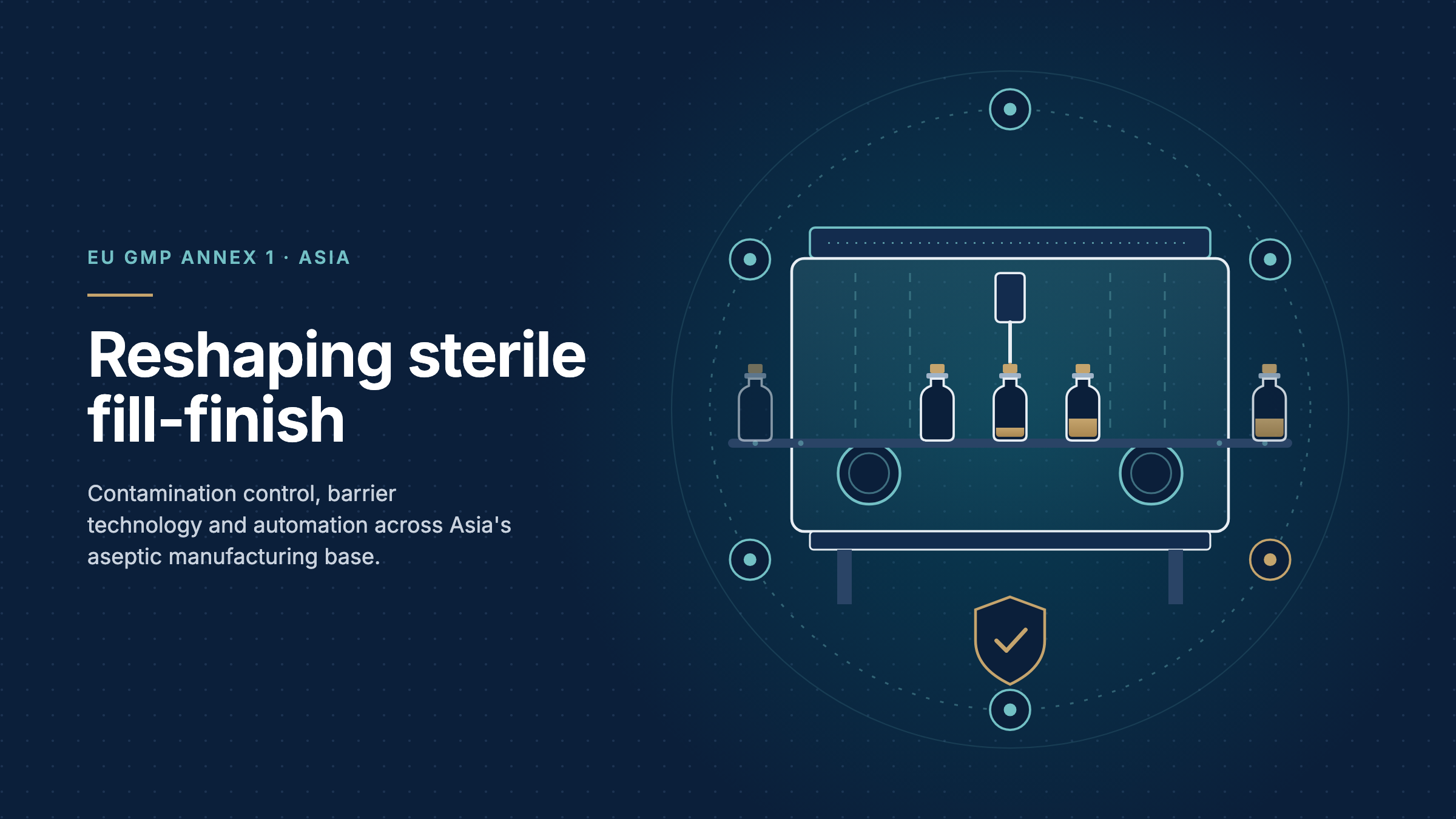
The revised EU GMP Annex 1 has moved sterile manufacturing from a checklist of controls to a documented, site-wide contamination control strategy. This article looks at what the revision changed, why it matters well beyond Europe, and how manufacturers and CDMOs across Asia are responding with barrier technology, automation and new fill-finish investment.
Introduction
Sterile injectables are among the hardest medicines to make. Biologics, vaccines and complex injectables cannot be terminally sterilised, so sterility has to be built into every step of aseptic processing, from the cleanroom and the people in it to the filling line, the container and the final inspection.
The rules for doing that changed with the revised EU GMP Annex 1, "Manufacture of Sterile Medicinal Products". Published in August 2022 and in force since August 2023, it was the first full rewrite of the guideline in more than a decade. Its influence now reaches far beyond Europe, and Asia's sterile manufacturing base is adjusting to it.
What changed: from controls to a contamination control strategy
The biggest shift is conceptual. The revised Annex 1 asks every sterile site to define and maintain a Contamination Control Strategy (CCS): a single, documented view of how the facility, equipment, people, utilities, materials and processes work together to prevent microbial, particle and endotoxin contamination.
Quality risk management sits at the centre of the strategy. Rather than meeting a fixed list of requirements, manufacturers must show why each control is in place, how it is monitored and how it is reviewed over time.
Several technical expectations also became more explicit:
Barrier technology: restricted access barrier systems (RABS) and isolators are expected to be considered as the preferred way to separate operators from the aseptic process.
Filter integrity: sterilising filters are expected to be tested for integrity before use and after sterilisation (PUPSIT), unless a documented risk assessment justifies otherwise.
Environmental and process monitoring: monitoring is expected to be continuous and risk-based in the critical zones, with data trended rather than only checked against limits.
Validation and media fills: aseptic process simulations must reflect worst-case conditions, including interventions, shift lengths and line configurations.
Why a European guideline matters in Asia
Annex 1 was revised jointly by the European Commission, the European Medicines Agency, PIC/S and the World Health Organization, and PIC/S adopted it as part of its own GMP guide. That makes it the reference point for many regulators across Asia-Pacific that are PIC/S participating authorities, including those in Singapore, South Korea, Japan, Taiwan, Malaysia, Thailand, Indonesia and Australia.
The commercial logic is just as strong. Asian manufacturers and CDMOs that supply Europe, or that want to, are inspected against Annex 1. Global sponsors choosing a fill-finish partner in the region increasingly ask for a mature CCS as part of technical due diligence, whatever the destination market.
Elsewhere, national standards are converging in the same direction. India's revised Schedule M, notified at the end of 2023, raised domestic GMP requirements for its very large injectable manufacturing base and brought them closer to WHO and international expectations.
How manufacturers are responding
Across the region, the response is showing up in capital plans and on the factory floor.
Barrier-first line design: new aseptic filling lines are increasingly specified with isolators from the outset, while older open or conventional cleanroom lines are being upgraded to RABS or scheduled for replacement.
Automation and robotics: robotic filling and gloveless isolators reduce human intervention, the largest single source of contamination risk in a Grade A zone.
Ready-to-use components: pre-sterilised, nested vials, syringes and cartridges remove washing and depyrogenation steps and simplify the contamination control story for multi-product sites.
Data and monitoring: continuous viable and non-viable particle monitoring, electronic batch records and trend analysis are being adopted to give the CCS a live evidence base.
Inspection: automated visual inspection is spreading as expectations on particulate and container defects tighten.
The pressure on CDMOs
Fill-finish is often the tightest point in the biologics supply chain, and CDMOs carry much of the regional capacity. For them, Annex 1 is both a cost and a differentiator.
Multi-product, multi-format lines have to show that changeovers, cleaning and line clearance are controlled within one coherent strategy. Lyophilisation, prefilled syringes and cartridges for self-injection devices add further complexity.
CDMOs that can show a mature, well-documented CCS and modern barrier lines are better placed to win programmes from global sponsors. Those running older lines face a choice between upgrading, narrowing their product scope or competing mainly on price.
What to watch
Inspection findings: how regulators in the region interpret the CCS requirement in practice, and which gaps appear most often in inspection reports.
PUPSIT decisions: how manufacturers justify, or decide against, pre-use post-sterilisation integrity testing for their filtration set-ups.
Capacity investment: new fill-finish lines and sites announced by CDMOs and innovators in Singapore, South Korea, Japan, China, India and Southeast Asia.
Skills: aseptic operators, sterility assurance specialists and validation engineers remain scarce, and training programmes will need to keep pace with new technology.
The Connexius perspective
The revised Annex 1 has turned sterility assurance from a compliance exercise into a strategic question about how sterile sites are designed, automated and run. In Asia, where sterile manufacturing capacity is growing quickly across biologics, vaccines and complex injectables, the companies that treat the contamination control strategy as a living management tool, not a document, will set the standard for the region.
These are the questions Sterile Manufacturing & Fill-Finish Asia 2027 will explore in Singapore on 12–13 October 2027, bringing together manufacturers, CDMOs, technology providers and regulatory experts working on aseptic processing, contamination control, isolators and RABS, lyophilisation, inspection and validation.
Frequently asked questions
- What is EU GMP Annex 1?
- EU GMP Annex 1 is the European guideline for manufacturing sterile medicinal products. The revised version was published in August 2022 and came into force in August 2023, and PIC/S adopted it as part of its own GMP guide.
- What is a contamination control strategy (CCS)?
- A CCS is a documented, site-wide strategy describing how the facility, equipment, personnel, utilities, materials and processes work together to prevent contamination, and how those controls are monitored and reviewed.
- Does Annex 1 apply to manufacturers in Asia?
- It applies to any site supplying the European market, and it is the reference for many Asia-Pacific regulators that participate in PIC/S, including those in Singapore, South Korea, Japan, Taiwan, Malaysia, Thailand and Indonesia.
- What is PUPSIT?
- PUPSIT stands for pre-use post-sterilisation integrity testing: checking that a sterilising filter is intact after it has been sterilised and before it is used. Annex 1 expects it unless a documented risk assessment justifies an alternative.