
Could Four 2,000 L Single-Use Bioreactors Outperform One 10,000 L Stainless-Steel Reactor?
Biologics manufacturing productivity depends on more than installed bioreactor volume. This article compares four 2,000 L single-use bioreactors with one 10,000 L stainless-steel reactor and examines how turnaround time, utilisation, titre, downstream capacity and manufacturing strategy can determine annual output.
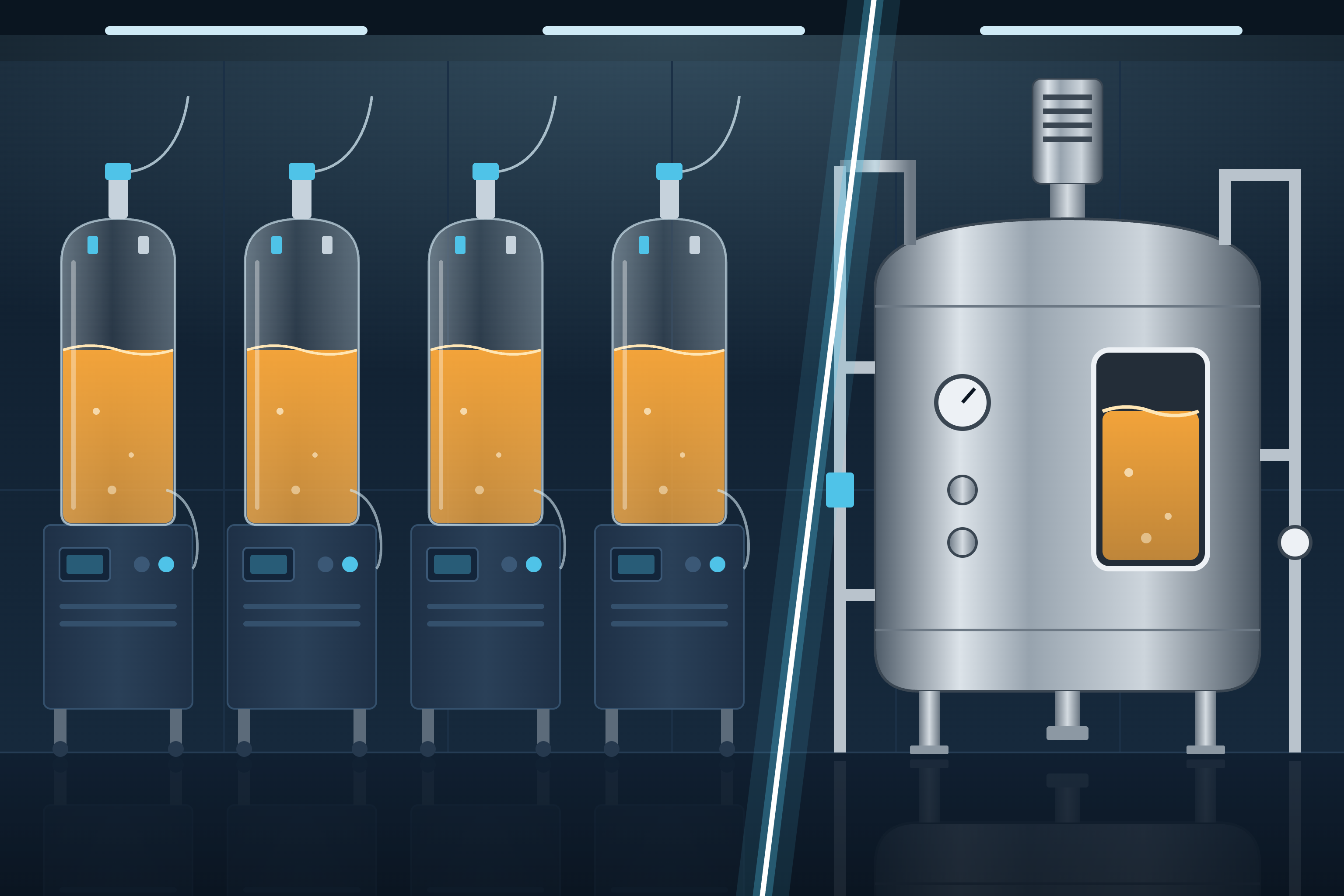
Could Four 2,000 L Single-Use Bioreactors Outperform One 10,000 L Stainless-Steel Reactor?
Rethinking Manufacturing Productivity: Why Bigger Is Not Always Better in Biologics Manufacturing
The Changing Economics of Biologics Manufacturing
For decades, the expansion of biologics manufacturing has been closely associated with increasingly large stainless-steel bioreactors.
From 2,000 L production vessels to 10,000 L and 20,000 L manufacturing systems, the traditional approach to increasing output has often involved building larger facilities, installing greater production capacity, and achieving economies of scale.
However, the emergence of advanced single-use technologies, intensified cell culture processes, and modular manufacturing facilities is challenging the assumption that larger bioreactors necessarily deliver greater manufacturing productivity.
Consider a question:
Could a facility operating four 2,000 L single-use bioreactors produce more biologics annually than a facility operating one 10,000 L stainless-steel bioreactor?
At first glance, the answer might seem obvious.
The stainless-steel facility has 25% more installed capacity relative to the single-use facility.
But manufacturing productivity is not determined by installed volume alone.
It depends on several interconnected factors, including product titre, batch turnaround time, equipment utilisation, process scheduling, downstream capacity, and operational efficiency.
Under certain manufacturing conditions, a smaller and more flexible facility could outperform a larger conventional production system.
The implications are particularly relevant for Asia, where biologics manufacturers and CDMOs are investing in new production facilities, expanding manufacturing capabilities, and evaluating technologies that offer greater flexibility without compromising product quality.
The Manufacturing Comparison: 8,000 L vs. 10,000 L
To understand how manufacturing efficiency can influence annual biologics output, consider two hypothetical commercial monoclonal antibody manufacturing facilities operating fed-batch processes.
Facility A: Single-Use Manufacturing
The first facility operates four independent 2,000 L single-use bioreactors, providing a combined nominal production capacity of 8,000 L.
Assuming a product titre of 4 g/L, an overall production cycle of 17 days, and an effective facility utilisation rate of 85%, the facility could theoretically generate approximately 584 kg of harvested monoclonal antibody annually.
Facility B: Stainless-Steel Manufacturing
The second facility operates one 10,000 L stainless-steel bioreactor.
Assuming the same product titre of 4 g/L, but with a 21-day overall production cycle and an effective utilisation rate of 75%, its estimated annual harvested output would be approximately 521 kg.
The surprising result?
Despite having 20% less nominal bioreactor capacity, the single-use configuration produces approximately 12% more harvested product annually under these hypothetical operating conditions.
The difference is not attributable to single-use technology inherently producing higher titres.
Instead, the model assumes that the single-use configuration benefits from shorter overall production cycles and greater effective utilisation.
Over an entire year, these operational advantages can offset the difference in installed capacity.
However, the comparison is illustrative rather than representative of actual manufacturing facilities. Both configurations are assumed to operate at nominal volume, with no limitations from downstream processing, equipment availability, or batch failures.
The broader implication is clear: Installed capacity alone does not determine manufacturing productivity.
Why Batch Turnaround Time Matters
One of the most significant differences between single-use and stainless-steel manufacturing is the preparation required between production batches.
Traditional stainless-steel systems generally require validated cleaning and sterilisation procedures.
Depending on the facility and manufacturing process, these activities may include cleaning-in-place (CIP), sterilisation-in-place (SIP), equipment inspections, cleaning verification, and preparation for subsequent manufacturing campaigns.
Single-use systems replace product-contact components with presterilised disposable assemblies.
This can eliminate the need to clean and sterilise the bioreactor's internal product-contact surfaces between batches.
For manufacturers operating multiple products, this distinction can be particularly important.
Imagine two facilities completing a 14-day cell culture process.
A single-use facility might require three additional days for harvest-related activities, assembly replacement, preparation, and turnaround.
A stainless-steel facility might require seven additional days because of its particular cleaning, sterilisation, and equipment scheduling requirements.
These hypothetical differences produce total cycle times of 17 and 21 days, respectively.
Over a full year, seemingly small differences in turnaround time can accumulate into meaningful changes in available manufacturing capacity.
However, stainless-steel facilities with highly automated cleaning systems, optimised scheduling, and efficient production campaigns may achieve considerably shorter turnaround times.
Therefore, the relevant comparison is not simply disposable versus reusable equipment.
It is the total time required to complete one manufacturing cycle and prepare the facility for the next.
The Advantage of Parallel Manufacturing Trains
A second potential advantage of multiple single-use bioreactors is operational flexibility.
Consider a manufacturer operating four independent 2,000 L production trains.
Instead of starting every batch simultaneously, the manufacturer could stagger production schedules.
For example, the first reactor could begin production on Day 1, followed by the second on Day 5, the third on Day 9, and the fourth on Day 13.
This arrangement could distribute harvest activities across different days rather than creating one concentrated downstream processing requirement.
It may also allow manufacturers to adjust production schedules according to customer demand, equipment availability, or product requirements.
For CDMOs manufacturing several products, this flexibility can be particularly valuable.
A manufacturer could potentially dedicate separate reactors to different client programmes, provided appropriate segregation, process validation, and contamination-control requirements are met.
By comparison, a single 10,000 L reactor represents a larger concentration of production capacity in one vessel.
If the reactor becomes unavailable because of maintenance or an unexpected technical issue, the entire upstream production capacity associated with that vessel may be affected.
Multiple smaller reactors distribute this operational exposure.
Nevertheless, parallel manufacturing creates additional complexity.
Four production trains may require more operators, seed-train capacity, equipment preparation, batch documentation, process monitoring, and quality oversight.
More frequent harvests may also increase pressure on downstream purification operations.
The real advantage is not simply having more reactors. It is having the infrastructure and operational systems to use those reactors efficiently.
Real Industry Example: Amgen's Next-Generation Biomanufacturing Facility in Singapore
One of the most compelling examples of a different approach to biologics manufacturing can be found in Singapore.
In 2014, Amgen introduced its next-generation biomanufacturing facility in Tuas Biomedical Park.
The facility was designed around advanced manufacturing technologies intended to improve speed, productivity, flexibility, and environmental performance.
According to Amgen, its next-generation manufacturing approach enabled a facility to be built in approximately half the construction time and at roughly one-quarter of the capital cost associated with conventional alternatives.
Amgen also reported approximately half the operating cost for its Singapore facility compared with conventional manufacturing approaches.
In an earlier corporate presentation, the company projected that next-generation biomanufacturing could reduce the cost per gram of protein by 60% or more.
These are company-reported comparisons and projections for Amgen's integrated manufacturing approach, not general performance benchmarks for every single-use facility.
Nevertheless, the example highlights an important shift in manufacturing strategy.
Rather than relying exclusively on larger production vessels, manufacturers can combine flexible production technologies, process intensification, compact facility design, and automation to improve manufacturing economics.
For Singapore, this approach also illustrates how advanced biomanufacturing can support high-value production in a market where industrial land, skilled labour, and manufacturing infrastructure represent substantial investment considerations.
The broader lesson is that facility design and process efficiency can be just as important as production scale.
Real Industry Example: Fujifilm's 5,000 L Single-Use Bioreactors in Japan
Another important development is taking place in Japan.
In December 2025, Fujifilm announced the completion of a major bio-CDMO facility in Toyama Prefecture, with operations scheduled to begin in 2027.
The facility incorporates two 5,000 L single-use mammalian cell culture bioreactors and two additional 2,000 L bioreactors, providing a total of 14,000 L of nominal bioreactor capacity.
The two 5,000 L systems are among the largest single-use bioreactors deployed for mammalian cell culture.
This development is particularly interesting because single-use manufacturing has historically been associated with smaller production volumes, commonly around 2,000 L or below.
The deployment of 5,000 L single-use systems suggests that the practical scale of disposable bioprocessing technology is continuing to evolve.
Larger single-use systems could potentially reduce the number of parallel production trains needed to achieve a particular manufacturing output.
However, increasing single-use bioreactor size also creates engineering challenges.
Manufacturers must consider oxygen transfer, mixing efficiency, carbon dioxide removal, mechanical stress, bag integrity, and process scalability.
The Fujifilm example demonstrates that the discussion is no longer limited to whether manufacturers should choose 2,000 L single-use or 10,000 L stainless-steel systems.
Emerging manufacturing configurations are creating additional options between those traditional scales.
Real Industry Example: Samsung Biologics and the Continued Importance of Large-Scale Manufacturing
While single-use technology continues to expand, large-scale manufacturing remains central to the global biologics industry.
Samsung Biologics provides a strong example of why manufacturing scale continues to matter.
In April 2025, the company opened Plant 5 at its Songdo manufacturing campus in South Korea.
The facility added 180,000 L of manufacturing capacity, bringing Samsung Biologics' total capacity to 784,000 L at that time.
The company announced an investment exceeding KRW 1.9 trillion in Plant 5.
Samsung Biologics' expansion demonstrates the continuing importance of large-scale production infrastructure for global pharmaceutical supply chains.
For high-volume commercial monoclonal antibodies with predictable demand, large-scale production systems can offer important economic advantages.
These may include economies of scale across manufacturing campaigns, lower consumable expenditure per unit of product, established process control and operating procedures, and efficient production of large commercial volumes.
Samsung Biologics is not presented here as a direct operating comparison with the hypothetical four-reactor single-use facility.
Rather, its investment illustrates why large-scale manufacturing remains commercially attractive even as more flexible technologies emerge.
The future of biologics manufacturing is unlikely to involve one technology completely replacing the other.
Instead, manufacturers may increasingly select different configurations according to product demand, process characteristics, production volumes, and commercial strategy.
The Productivity Equation: Why Titre Changes Everything
Manufacturing productivity is influenced not only by reactor volume and operating schedules but also by the concentration of product achieved during cell culture.
This concentration, commonly expressed as grams per litre, is known as product titre.
Consider a simplified comparison.
A 2,000 L bioreactor operating at a titre of 4 g/L produces approximately 8 kg of harvested product per batch.
At a titre of 6 g/L, the same reactor produces approximately 12 kg per batch.
That represents a 50% increase in harvested product without increasing the reactor's working volume.
For a facility operating four such reactors, improvements in titre could substantially increase annual output.
However, higher titres are not automatically achieved through single-use technology.
They depend on cell-line performance, media development, feeding strategies, process control, oxygen transfer, and other biological and engineering factors.
This is why process intensification has become increasingly important.
Technologies such as intensified fed-batch processing, high-density cell culture, and perfusion can potentially increase productivity without requiring proportional increases in installed vessel capacity.
For manufacturers evaluating new facilities, the combination of titre, process duration, volumetric productivity, and downstream recovery may be more informative than reactor size alone.
What Happens When Stainless Steel Performs Better?
Although single-use manufacturing can offer operational flexibility, larger stainless-steel bioreactors retain significant advantages in certain commercial production environments.
Consider a second hypothetical scenario in which both facilities operate under identical manufacturing conditions.
Both achieve a product titre of 4 g/L, complete an overall production cycle every 18 days, and maintain an effective utilisation rate of 85%.
Under these conditions, the four 2,000 L single-use bioreactors would theoretically produce approximately 552 kg of harvested monoclonal antibody annually.
The 10,000 L stainless-steel bioreactor, operating under the same conditions, would generate approximately 689 kg annually.
That represents approximately 25% more annual harvested product from the stainless-steel configuration.
The reason is straightforward.
When titre, production cycle duration, and utilisation are identical, the larger bioreactor configuration benefits directly from its greater installed capacity.
For manufacturers producing high-volume commercial biologics with predictable demand, this scale advantage can be particularly important.
Large stainless-steel facilities may also achieve lower consumable costs per gram of product, particularly when operating long, consistent manufacturing campaigns.
Conversely, single-use systems may offer advantages when manufacturing multiple products, managing smaller production volumes, or responding to fluctuating customer demand.
The most appropriate technology therefore depends on the manufacturing strategy, not simply the size or type of bioreactor.
Ultimately, manufacturers should evaluate annual output, cost per gram, facility utilisation, product flexibility, and long-term operating requirements before selecting their production platforms.
The Hidden Challenge: Downstream Processing Capacity
A critical limitation of many simplified upstream manufacturing comparisons is the assumption that additional bioreactor output can automatically be converted into finished drug substance.
In reality, downstream processing can become a major constraint.
A facility operating four parallel single-use bioreactors must ensure sufficient capacity for harvest clarification, chromatography, viral clearance, filtration, and associated process operations.
If upstream batches are completed faster than downstream equipment can process them, additional reactor capacity may not translate into higher annual finished-product output.
For example, a facility could theoretically produce more than 580 kg of harvested monoclonal antibody annually but recover substantially less purified product after downstream processing losses.
The actual recovery depends on the process, product characteristics, and purification strategy.
Manufacturers must therefore evaluate productivity across the entire manufacturing process.
This includes coordinating upstream and downstream schedules, optimising purification cycles, and ensuring sufficient capacity for buffer preparation, filtration, and product storage.
A flexible upstream facility connected to an inflexible downstream process may fail to achieve its theoretical productivity advantage.
This is particularly relevant as the industry explores intensified and continuous manufacturing strategies.
The next major productivity improvement may come not from increasing bioreactor volume, but from integrating upstream and downstream operations more effectively.
What Does This Mean for Asia's Biologics Manufacturing Industry?
Across Asia, biologics manufacturers are making significant investments in new facilities and manufacturing technologies.
South Korea continues to expand its large-scale CDMO infrastructure.
Singapore has demonstrated the commercial potential of advanced and compact biomanufacturing facilities.
Japan is investing in larger single-use production technologies.
Meanwhile, manufacturers across China, India, and Southeast Asia are evaluating how flexible manufacturing platforms can support biosimilars, vaccines, monoclonal antibodies, and emerging biologic modalities.
These developments raise several strategic questions.
Should manufacturers prioritise maximum installed production capacity or maximum annual output?
Would multiple smaller production trains provide greater flexibility for CDMOs managing different customer programmes?
Can process intensification reduce the economic need for increasingly large bioreactors?
And how should manufacturers balance the operational benefits of disposable systems against their consumable costs, supply-chain dependencies, and environmental considerations?
There is unlikely to be a universal answer.
For a company producing a high-volume monoclonal antibody with stable global demand, large-scale stainless-steel manufacturing may offer compelling advantages.
For a CDMO managing multiple products, smaller campaigns, and uncertain demand forecasts, flexible single-use configurations may be more attractive.
For emerging biologics manufacturers, hybrid facilities incorporating both technologies may offer an effective balance between manufacturing flexibility and commercial scale.
Conclusion: The Future of Biologics Manufacturing Is About Productivity, Not Just Capacity
The comparison between four 2,000 L single-use bioreactors and one 10,000 L stainless-steel bioreactor illustrates a broader transformation in biologics manufacturing.
Installed capacity remains important, but it is only one component of manufacturing performance.
Under the illustrative assumptions presented, the single-use configuration achieves approximately 12% higher annual harvested output despite having 20% less nominal capacity.
Under identical operating conditions, however, the larger stainless-steel configuration delivers more product.
Neither result establishes one technology as universally superior.
The more meaningful measures are annual manufacturing output, facility utilisation, product recovery, cost per gram, production flexibility, and supply reliability.
As Asia's biopharmaceutical manufacturing industry continues to evolve, the companies that succeed may not necessarily be those with the largest bioreactors.
They may be those that design and operate their manufacturing systems most effectively.
The question for the industry is no longer simply: How much bioreactor capacity do we have?
It is: How much high-quality biologic product can we reliably manufacture with the capacity we have?