
Is the JS-SEZ Becoming Southeast Asia’s Next Life Sciences & MedTech Manufacturing Hub?
The JohorÐSingapore Special Economic Zone (JS-SEZ) has drawn RM88.83 billion (S$28.1 billion) in approved investments in its first 18 months, and a life sciences and MedTech cluster is quietly forming inside it.
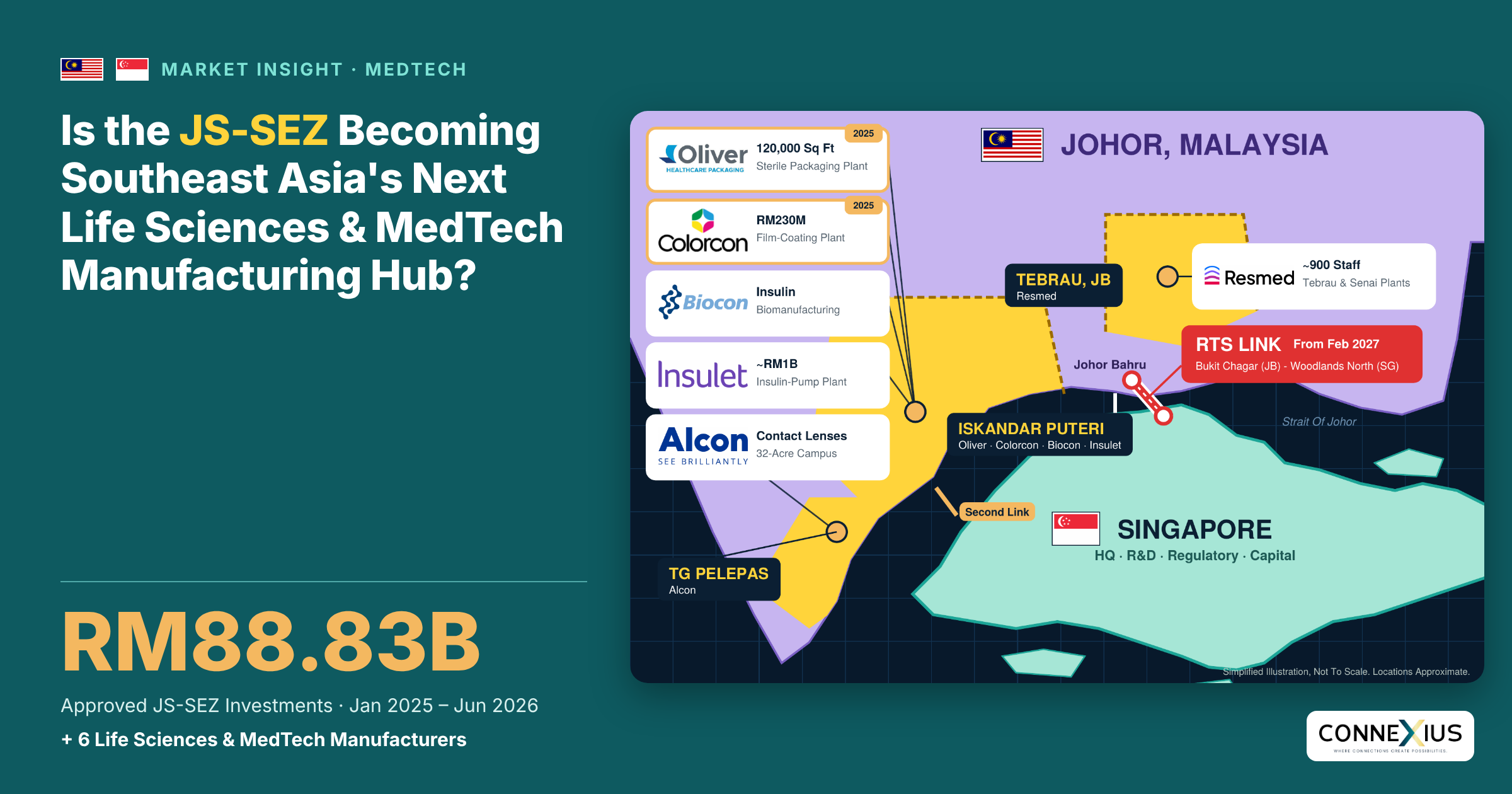
Is the JS-SEZ Becoming Southeast Asia’s Next Life Sciences & MedTech Manufacturing Hub?
On Monday, 2 November 2026, the Johor-Singapore Cooperation Ministerial Committee (JSCMC) held its first meeting at the Flower Field Hall, Gardens by the Bay. SingaporeÕs Minister for National Development Chee Hong Tat called it Òreally the beginning of many more to comeÓ. MalaysiaÕs Minister of Economy Akmal Nasir described the numbers as ÒamazingÓ, adding that the results were Òreally beyond many expectationsÓ.
Most coverage of the zone focuses on data centres. This article looks at a less discussed question: is the JS-SEZ becoming Southeast AsiaÕs next life sciences and MedTech manufacturing hub?
The numbers so far
About 45% of the approved money is already on the ground, according to the committeeÕs joint statement. For January 2025 to June 2026:
Approved investments, all sectors: RM88.83 billion (S$28.1 billion)
Already implemented: RM40.3 billion (about 45%)
Jobs linked to implemented projects: 12,796
Potential jobs from all approved projects: 28,755
The zone covers 3,571 sq km across nine flagship areas and 11 economic sectors, including health. Its targets are 50 projects in the first five years, 100 in the first decade, and 20,000 skilled jobs.
The RM88.83 billion covers every sector, from data centres to logistics. Life sciences and MedTech are a smaller slice, so the case for a cluster rests on the companies already operating there, covered below.
Three milestones are next:
JS-SEZ master plan and investment blueprint: expected by the end of 2026, at the 13th MalaysiaÐSingapore LeadersÕ Retreat.
Joint investment forum: agreed for the first quarter of 2027.
Johor BahruÐSingapore RTS Link: passenger service from February 2027, linking Bukit Chagar to Woodlands North.
Government support: medical devices are named for the 5% tax rate
The incentive that matters most for this sector is a 5% corporate tax rate for up to 15 years on qualifying new investments. Medical devices is one of the named eligible sectors, alongside AI, quantum computing and aerospace.
Other support for companies in the zone:
15% income tax: a flat rate for eligible knowledge workers in the zone, for 10 years.
Invest Malaysia Facilitation Centre Johor (IMFC-J): a one-stop centre for applications, approvals and reinvestment.
SingaporeÕs JS-SEZ Project Office: MTI, EDB and EnterpriseSG help firms set up on both sides of the border.
Faster borders: passport-free QR clearance, automated lanes, paperless customs, and one transhipment permit instead of two.
At the 2 November meeting, both sides also noted MalaysiaÕs Budget 2027 measures for the zone. These include Nexus Sedenak, a new industrial and supply chain hub, along with better transport links and stronger financial services in Forest City.
For MedTech and pharma firms, the incentives matter less on their own than in combination. Lower tax and faster approvals in Johor sit next to SingaporeÕs regulatory standing, talent and export links, just across the Strait of Johor.
The cluster: six manufacturers already in Johor
Six global life sciences and MedTech manufacturers already make products in southern Johor, and two of them opened new plants in 2025. Four sit in or near Iskandar PuteriÕs SiLC and i-Tech Valley industrial parks.
Oliver Healthcare Packaging: a new plant inside the zone
Oliver opened a 120,000 sq ft cleanroom plant in i-Tech Valley, Iskandar Puteri, in May 2025, its largest site in Asia-Pacific. It makes sterile-barrier pouches, lids and rollstock for medical device and pharma companies, in ISO-7 and ISO-8 cleanrooms. The plant works alongside OliverÕs technical lab in Singapore.
Colorcon: pharma supply chain in the same park
Colorcon opened a 200,000 sq ft film-coating plant in July 2025, in the same industrial park as Oliver. Bernama reported a RM230 million investment when the project was announced in 2023. It is ColorconÕs 16th manufacturing site worldwide and serves pharmaceutical customers across Asia Pacific. ÒWe are thrilled to open this world-class facility to support our pharmaceutical customers throughout Asia,Ó said CEO Simon Tasker.
Biocon Biologics: AsiaÕs largest integrated insulin facility
BioconÕs 562,000 sq ft plant at SiLC, Iskandar Puteri, is described by the company as AsiaÕs largest integrated insulin manufacturing and R&D facility, built with more than US$350 million. It is the first and only sterile injectables plant in Malaysia approved by both the US FDA and the European Medicines Agency. Its insulin glargine became the first interchangeable biosimilar approved by the US FDA, in 2021.
Insulet: twice the size of its US home plant
Insulet opened a 400,000 sq ft Omnipod plant on a 13-acre site in Johor Bahru in August 2024, part of a US$200 million investment. The plant is twice the size of its highly automated facility in Acton, Massachusetts. It started with more than 350 staff and plans to grow beyond 1,000, and over 5,700 solar panels supply about 15% of its power.
Resmed: Johor as a global centre of excellence
Resmed employs about 900 people across two Johor plants making mask headgear, in Tebrau (since 2010) and i-Park SAC, Senai (since 2022). Johor is its global centre of excellence for headgear process expertise. Its twinning with Singapore is covered in the next section.
Alcon: two decades of lens-making at Tanjung Pelepas
Alcon runs a 32-acre contact lens campus at the Port of Tanjung Pelepas, operating as Ciba Vision Johor since 2005. The site makes sterile soft contact lenses for global markets, including nearly all of AlconÕs AIR OPTIX lenses. Singapore EDB lists Alcon as a JS-SEZ Òtwinning in actionÓ company.
The twinning model: Singapore leads, Johor scales
The strongest sign of a real cluster is not plant size but how companies split work across the border. Resmed and Alcon both run Singapore and Johor as one operation, and Singapore EDB names both as Òtwinning in actionÓ examples.
Resmed
Singapore: Asia Pacific headquarters, its largest global manufacturing site for mask systems, and an R&D hub for new products, AI and process innovation.
Johor: cost-competitive, high-volume headgear production, and the global centre of excellence for headgear processes.
How the sites connect: Johor-made sub-components go to Singapore for final assembly and export, and Singapore provides management oversight and technical support.
Alcon
Singapore: the Singapore Replenishment Centre (SRC) coordinates logistics for both sites.
Johor: contact lens manufacturing at the Port of Tanjung Pelepas.
How the sites connect: shared HR and commercial team heads, an on-demand cross-border engineering support team, and pooled procurement for economies of scale.
The pattern is consistent. Singapore keeps the functions that depend on regulation, talent density and global links: headquarters, R&D, final assembly and export. Johor takes the work that needs land, labour and room to grow quickly.
ResmedÕs Nigel Cheong put it this way: twinning helped the company find Òthe right balance between cost effectiveness, resilience and synergy between Singapore and JohorÓ.
What to watch in 2027
Whether this becomes a recognised hub depends on what happens over the next 12 months.
The master plan. It was first due in March 2026 and is now expected by year-end. Investors will look for sector-specific plans for health and medical devices, not only headline targets.
Implementation, not approvals. RM48.5 billion of approved investment is not yet on the ground. The share that turns into working plants is the number to track.
Talent. Cleanroom, quality and regulatory staff are scarce. The 15% knowledge-worker tax rate and joint talent programmes will be tested as MedTech competes with data centres for engineers.
Infrastructure and utilities. Both governments say power, water and land planning are being coordinated with expected investment. Pharma and MedTech plants need reliable, high-quality utilities.
Cross-border movement. The RTS Link from February 2027 should make daily commuting for engineers and managers easier, which matters for any twinned operation.
More anchor investors. Two new plants in 2025 is a start. A cluster needs suppliers, contract manufacturers and testing labs to follow.
The bottom line
The JS-SEZ is not yet a life sciences and MedTech hub, but the building blocks are in place. Six global manufacturers already operate in southern Johor. Two new plants opened in 2025, and medical devices qualify for the zoneÕs lowest tax rate. Resmed and Alcon show the twinning model working in practice.
What turns a cluster into a hub is the next wave: suppliers, testing labs and more anchor investors, backed by a master plan that names health and MedTech as priorities. The year-end LeadersÕ Retreat and the Q1 2027 investment forum are the moments to watch.
Download the full briefing. Our 8-page visual briefing covers the investment numbers, government support, a map of the cluster and a profile of each company. [Download the PDF]