The ADC Boom: 15 Approved, ~440 in the Clinic, Nearly 2,000 in the Pipeline
Antibody-drug conjugates (ADCs) have grown from a small class of cancer medicines into one of pharma's most competitive development races. With 15 ADCs approved by the US FDA, around 440 programmes at Phase 1 or later and 1,838 active programmes in total, more than half of them from China, the question is shifting from discovery to supply: can manufacturing capacity keep pace?
From niche class to development race
Antibody-drug conjugates combine the targeting precision of a monoclonal antibody with a highly potent drug payload, joined by a chemical linker. The idea is simple: deliver the payload to cancer cells and spare healthy tissue. Turning it into approved medicines took decades, but the class is now one of the most active areas of oncology drug development.
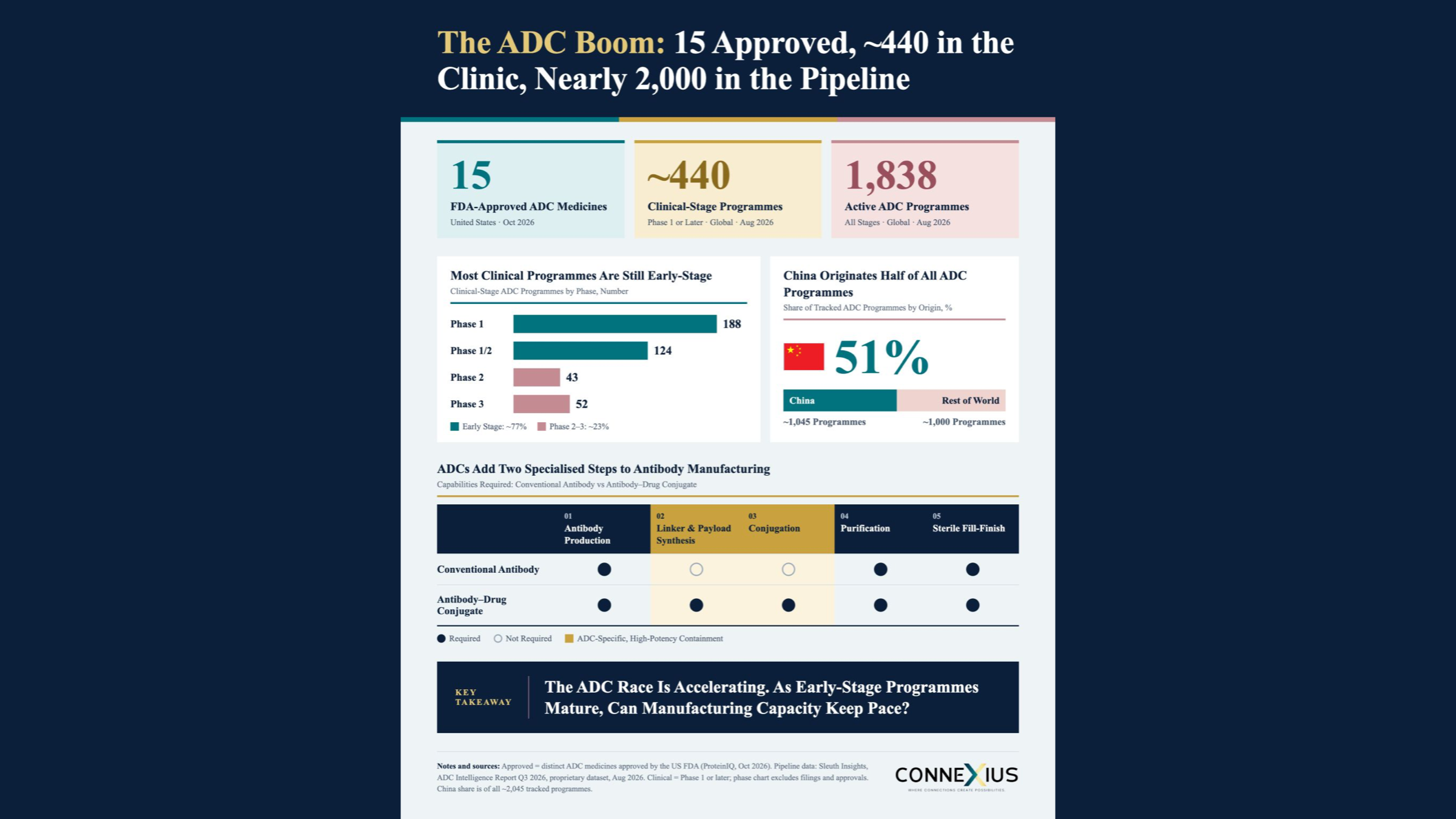
The numbers show how quickly the field has grown. There are 15 distinct ADCs approved by the US FDA, around 440 programmes at Phase 1 or later, and 1,838 active ADC programmes across all stages of development worldwide.
Most clinical programmes are still early-stage
Of the clinical-stage ADC programmes, 188 are in Phase 1 and 124 in Phase 1/2. A further 43 are in Phase 2 and 52 in Phase 3. That means about 77% of clinical programmes are still at an early stage, with roughly 23% in Phase 2 or 3.
This profile matters for manufacturing. Early-stage programmes need small clinical batches. As they advance into late-stage trials and commercial supply, their demand for conjugation capacity, payload supply and containment will rise sharply.
China originates half of all ADC programmes
Around 51% of tracked ADC programmes originate in China, roughly 1,045 programmes compared with about 1,000 in the rest of the world.
China's rise is being led by developers such as Kelun-Biotech, Hengrui Pharma, RemeGen Biosciences and Duality Biologics, whose ADCs are now reaching patients and attracting global partners. Elsewhere in Asia, Japan's Daiichi Sankyo has shown the global potential of Asian ADC innovation through its DXd technology, and South Korea's LigaChem Biosciences is advancing proprietary ADC platforms.
Why ADCs are harder to make
Making an ADC is far harder than making a conventional antibody. A conventional antibody needs antibody production, purification and sterile fill-finish. An ADC needs all of these, plus two specialised steps: linker and payload synthesis, and conjugation.
Those additional steps bring highly potent chemistry into a biologics process. Payloads are toxic at very low doses, so they must be handled with specialised high-potency containment, and the conjugation step must be controlled precisely to produce a consistent product. All of this has to sit under one quality system, which is why relatively few sites can manufacture ADCs end to end.
APAC is building dedicated ADC capacity
Across Asia-Pacific, contract manufacturers are investing to meet that demand. WuXi XDC, Samsung Biologics and LOTTE Biologics are among those building dedicated ADC capacity, with Samsung Biologics establishing ADC manufacturing capabilities in Songdo, South Korea.
With about three in four clinical programmes still in Phase 1 or 1/2, demand for conjugation capacity will only grow as these programmes move towards late-stage trials and commercial supply.
Where the bottlenecks could appear
Payload supply: highly potent payloads and linkers require specialised chemistry and containment, and few suppliers can produce them at commercial scale.
Conjugation slots: dedicated conjugation suites are expensive to build and qualify, so capacity can lag behind the number of programmes that need it.
Containment: handling highly potent compounds safely calls for specialised facilities, equipment and trained staff.
Integration: coordinating antibody, payload and conjugation steps across one quality system, or across several partners, adds complexity to tech transfer and scale-up.
The Connexius perspective
The ADC race is accelerating, and Asia is at the centre of it, both as a source of innovation and as a growing manufacturing base. As early-stage programmes mature, the competitive advantage will shift towards developers and manufacturers that can secure reliable payload supply, conjugation capacity and containment at scale.
These questions will be discussed at Connexius ADC Development & Manufacturing Asia 2028 in Seoul, South Korea, on 24–25 May 2028, which brings together ADC developers, CDMOs, linker-payload specialists and technology providers across discovery, CMC, analytics and commercial manufacturing.
Data: Sleuth Insights, ADC Intelligence Report Q3 2026 (proprietary dataset, August 2026); ProteinIQ (October 2026). Approved counts distinct ADC medicines approved by the US FDA. Clinical means Phase 1 or later; the phase breakdown excludes filings and approvals. China's share is of all ~2,045 tracked programmes.
Frequently asked questions
- What is an antibody-drug conjugate (ADC)?
- An ADC is a medicine that links a monoclonal antibody to a highly potent drug payload through a chemical linker. The antibody targets cancer cells and delivers the payload directly to them.
- How many ADCs are approved by the US FDA?
- As of October 2026, 15 distinct ADC medicines have been approved by the US FDA, according to ProteinIQ.
- How many ADC programmes are in development?
- There are 1,838 active ADC programmes across all stages globally, with around 440 at Phase 1 or later, according to Sleuth Insights data from August 2026.
- Why is ADC manufacturing more complex than antibody manufacturing?
- ADCs add two specialised steps to antibody manufacturing: linker and payload synthesis, and conjugation. Both involve highly potent compounds that require specialised containment under a single quality system.