
Stainless Steel vs Single-Use: Why Biomanufacturing Still Needs Both
Stainless steel and single-use systems serve different roles in modern biomanufacturing, with the right choice depending on production volume, product mix and demand certainty. This article examines how leading APAC facilities are combining scale, flexibility and resilience through steel, single-use and hybrid manufacturing strategies.
Stainless Steel vs Single-Use: Why Biomanufacturing Still Needs Both
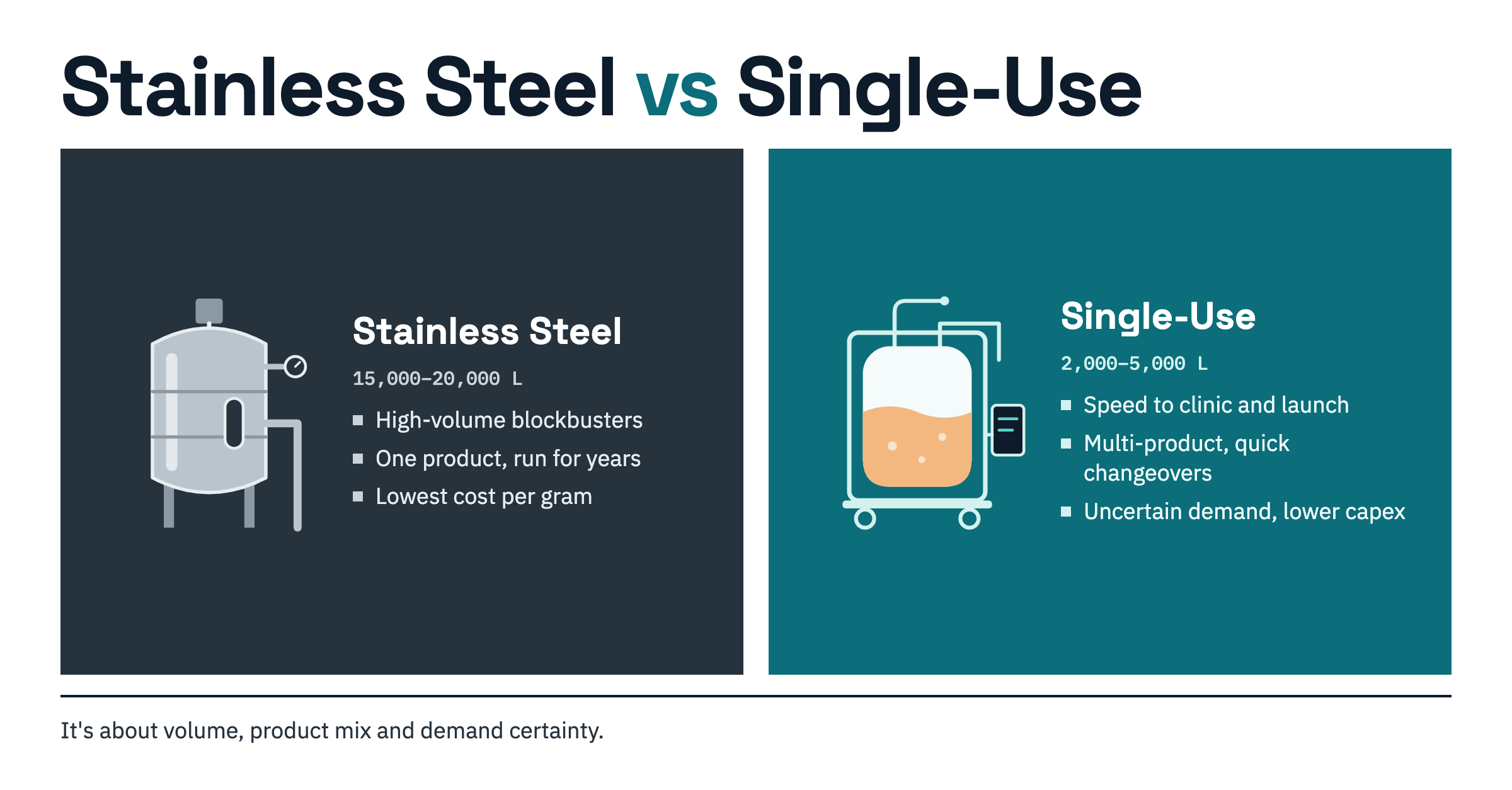
Walk into the world's biggest biologics plants and you'll see enormous stainless steel bioreactors, often 15,000–20,000 L each.
Walk into many newer facilities and you'll see something very different: single-use bioreactors, which are sterile plastic bags in a support frame. These are typically 2,000 L and rarely go above 5,000 L.
If single-use is the modern option, why are companies still building steel?
Asia-Pacific is one of the best places to look for the answer. The region now has some of the world's largest biologics plants and some of its most flexible ones, each built on a different bet.
Six Bets Across APAC
Korea: Steel at Scale
Samsung Biologics in Songdo operates about 784,000 L of capacity across five plants. Most of it comes from 15,000 L stainless steel bioreactors; Plant 5 alone has twelve of them (180,000 L). Nearby, Lotte Biologics completed its first Songdo plant in June 2026, with eight 15,000 L stainless steel bioreactors (120,000 L).
China: Scaling Out with Single-Use
WuXi Biologics took the opposite route. Its MFG5 site in Wuxi has been called the world's largest GMP facility using single-use bioreactors: nine 4,000 L units, totalling 36,000 L. Instead of one giant tank, it runs several bags in parallel at 4,000, 8,000, 12,000 or 16,000 L, depending on demand.
Singapore: Built for Flexibility
Sanofi's US$595 million modular facility in Tuas is designed to produce up to four vaccines or biologics at the same time and switch between products within days.
India: Repurposing with a Hybrid Approach
Syngene bought a Bengaluru plant originally built for COVID-19 vaccine production and converted it to make monoclonal antibodies. The site now has 20,000 L of single-use capacity (ten 2,000 L bioreactors), supported by smaller stainless steel vessels for scale-up, with space to add another 20,000 L. It shows how quickly single-use capacity can be redeployed when the market changes.
Japan: Single-Use at the Upper Limit
AGC Biologics is installing two 5,000 L single-use bioreactors at its new Yokohama site, with GMP operations expected in 2027. That's near the top of what single-use can do today, and it's aimed at domestic demand for both clinical and commercial supply.
Australia: Building for Surge and Sovereign Supply
CSL Seqirus opened a A$1 billion cell-based vaccine facility in Melbourne in December 2025, the first of its kind in the Southern Hemisphere. It will make seasonal and pandemic influenza vaccines, antivenoms and Q fever vaccines. Here the priority is the ability to respond quickly in a crisis, more than cost per gram.
So who's right? All of them. The real question isn't steel vs plastic. It comes down to three factors: volume, product mix and demand certainty.
Volume: Where Steel Still Wins
For a high-volume blockbuster, scale matters. One large tank running the same product for years gives the lowest cost per gram. Once a steel plant is built and validated, every extra batch is relatively cheap.
That's the logic behind Korea's mega-plants: they're built to supply high-volume commercial antibodies to global markets.
Steel also avoids dependence on consumables. Many in the industry still remember the single-use bag shortages during COVID.
The trade-off: steel facilities are expensive and take years to design, build and qualify. Cleaning and sterilising between batches (CIP/SIP) also uses a lot of water, steam and chemicals.
Product Mix: Where Single-Use Wins
CDMOs and multi-product sites may switch products frequently. Every switch in a steel plant means cleaning, validation and downtime.
With single-use, every batch starts with a fresh, pre-sterilised bag. Changeovers are faster, the risk of cross-contamination is lower, and the bioreactor itself needs no cleaning validation.
This is why flexible sites, from Sanofi in Singapore to AGC Biologics in Japan, lean towards single-use and modular design.
Demand Certainty: The Deciding Factor
Building 20,000 L of steel is a big bet that demand will still be there in five years.
Single-use lowers the upfront investment and gets capacity online faster. That makes it well suited to clinical supply, new launches and products whose demand is still uncertain. When demand grows, companies can add more units instead of building one bigger tank. WuXi's scale-out model and Syngene's ready-to-expand site in India are both examples.
A Common Myth: “Single-Use Is Less Sustainable”
Single-use is often criticised for its plastic waste. Yet several lifecycle studies suggest it can have a comparable or even lower overall environmental footprint than steel once you count the water, steam and energy used to clean and sterilise steel between batches.
The real picture depends on the site, the energy mix and how waste is handled, but it's far less one-sided than many assume.
The Answer Is Often Hybrid
Many modern facilities combine both. They use single-use for the seed train, clinical batches and smaller products, and stainless steel for large-scale commercial production. Samsung's own Plant 2 includes single-use bioreactors alongside its 15,000 L steel tanks, while Syngene's Indian site pairs single-use production with steel scale-up vessels.
The gap is also narrowing. As titers rise and continuous and intensified processing matures, a 2,000 L bioreactor today can do work that once needed a much bigger tank. Litres alone no longer tell the full story.
What This Means for APAC
APAC's biomanufacturing growth isn't following one blueprint:
Korea is building scale and cost leadership for global commercial supply.
China has shown that single-use can reach commercial scale by scaling out.
Singapore is positioning itself around flexibility, speed and multi-product capability.
India is turning existing assets into flexible antibody capacity, quickly and at lower cost.
Japan is building modern single-use capacity to meet domestic demand.
Australia is investing in sovereign supply and pandemic readiness.
For companies planning capacity in the region, the question isn't which technology is better. It's which one fits your pipeline, your volumes and your appetite for risk.
The Takeaway
The best facilities aren't defined by their equipment. They're defined by how well that equipment matches the product, the volume and the timeline.
Stainless steel and single-use aren't rivals. They're tools for different jobs, and the region's leaders are using both.
What's your bet for APAC's next wave of capacity: steel, single-use or hybrid?